Showing posts with label activities. Show all posts

Wednesday, April 23, 2014

Graphs and Central Tendency

It has been a long time since my last post. We have been BUSY at school.  I have been covering for another teacher, so my evenings have been spent planning for another class.  It is a 7th grade class, so I was really having to regroup.

The kids were behind, so we were having to go in and hit all the concepts.  During this time of year (or any time of year for that matter), no one wants to be beat down with a bunch of notes.  Since I started doing an interactive journal in my 8th grade class, I thought I would go that route with these kids.  They responded so well!  They loved getting the information without feeling like they were copying down a bunch of "stuff".

During the fall, I reviewed over the different graphs and central tendency with my 8th graders.  I used turkeys and pumpkins.  I didn't think that theme would go well at this time of year, so I created baskets and bunnies.

Each basket represented a different graph.  The egg was glued on to each basket (in a slightly overlapping pattern), and it titled what the graph was.  The eggs serve as a tab for easy reference.  The graphs we reviewed were:

  • line plot
  • line graph
  • stem and leaf plot
  • bar graph
  • circle graph
  • venn diagram


Each bunny represented each measure of central tendency.  One ear was glued to each bunny (in a slightly overlapping pattern), and it detailed what the bunny covered.  When we finished we had a four-eared bunny!

Click here to get the template I used for the baskets/eggs and bunnies/ears.

The kids were able to go back and add some color to the foldable.  I loved seeing them pull them out and use them to help answer different questions.  The eggs and ears allowed for easy reference.  The kids were engaged and got the material I needed them to get.

The slowest part is the cutting!  I have found that when we do activities like this, it is best to go ahead and hand out the material when they come in, so they can start cutting as soon as they finish the bell ringer.  We also have to share scissors.  I plan on buying A LOT of scissors this summer!  Once you get past the cutting hurdle, it is smooth sailing!

Happy basket and bunny making!

Friday, February 7, 2014

REEL life math

For the past two years, I have assigned my advanced students the project of creating a real-life math video in which they teach a math problem.  It is part of a contest held by MathCounts.

I require the project for a grade, but the students have the option of submitting the video in the National contest.  For the first time, we have a team who has completed the submission process, and their video is in the contest.

The students did all the work on their own.  I was so impressed with the output.  Due to rights with music, they had to do a quick revision and create their own song.  They put a lot of time and effort into the project, and my other students enjoyed watching what they created.

I love it when students can go above and beyond the requirements.  I believe this is a great foundation tool for future endeavors.

Voting began February 4, 2014, and it runs through March 14, 2014.  Please take a minute and go vote for their video.  There is a quick login process, but it only takes a second.  You can vote every day!  The winning video wins scholarships for the team members.

Click here to vote:  http://videochallenge.mathcounts.org/videos/judes-cookie-challenge

http://videochallenge.mathcounts.org/videos/judes-cookie-challenge

Thank you for encouraging math to go beyond the boundaries of the school!

Happy Voting!

Thursday, February 6, 2014

Desks instead of paper

We start every class period with a bell ringer.  The students will have 2-4 problems that they must begin working when they come in the room.  After the bell ringer, they will do a quick one question quiz which reviews some concept we have previously discussed.  The quiz must follow the four step plan of: Read, think, solve and justify.

Of course, we have papers that they can keep the work organized, but this year I like to throw in a little different bell ringer every now and then.

One morning, I handed each student a dry erase marker when they walked in the room.  On the bell ringer screen, I included a box that stated to answer the bell ringer by writing on the desk with the dry erase marker.  I heard several gasps and "REALLY?"  They got to work and enjoyed the activity.

I typically give 2-4 minutes to complete bell ringer.  We usually switch papers and grade it.  On this occasion, we weren't really able to switch papers, so I told them to go on a field trip to somewhere else in the room.  This not only allowed them to get up and move, but it kept their attention.

After checking the bell ringer, they wiped off the desk and got ready for the quiz.  Most of the desks wipe off very well.  A few of the desks have a little different laminate, but a disinfectant wipe got the marker right off. Once the quiz was completed, they went on another field trip to somewhere they had never been before.

The kids really took to this.  I have thrown this in about once a month.  A few weeks ago, we had group work for 3 days, so each day I allowed the bell ringer and quiz to be done this way.  It provides a change-up and it helps to keep the kids excited about what the class may hold.

This was an example of one desk after the quiz.  I had all the kids take a trip to this desk to see what I look for in a justification.

It is great to give the kids a little surprise, and this surprise was FREE!

Happy Desk Writing!

Wednesday, February 5, 2014

Dilations & Scale Factor Journal entry

This year, I started an interactive journal in my math class.  I have LOVED it.  I can see such a difference in how the kids are understanding.  It allows for them to have a hands-on approach while learning how to take short notes that are to the point.  It is still a learning process, but I am loving the process!

A few years ago, I implemented, "Say NO to Oreos".  WHAT?????  Who could say NO to oreos?  We do this when we learn about scale factor.  The NO stands for New divided by Original.  We start this saying at the beginning of the year, and we use it all year.  In the past, I have always brought in three types of oreos:

  • regular
  • double stuft
  • mini

We go through a lesson in which we start with the regular oreo and dilate it through an enlargement (the two types of dilations were discussed the day before); therefore, the double stuft is created. The students measure the oreos, and we calculate the scale factor used.

We then have the regular oreo and dilate it through a reduction; therefore, the oreo mini is created.  We do more measurements and get that scale factor.

The students have always responded very well to this.   Since I started journaling this year, I created a journal entry, so the kids could put down what they took away from it.

After each situation, we put the oreos down in the journal.  The characteristic of each type of dilation was included.

I created a little pop out which included our saying that we taped to the middle of the page.

The pop out opens up to reveal what the NO stands for.

I love how we were able to keep something from this activity that the kids can go back and look at.  The kids loved to eat the oreos!!

I am excited to see the finished journal!

Happy Dilating!!

Wednesday, November 13, 2013

Punch board

It has been a while since my last post!  The whirlwind of school came in FAST!!  It has been non-stop since the first day of school.  I have been finding new things to do this year, and it has kept me busy.

My biggest thing is starting the interactive math journal.  I LOVE this!  I wish I would have started this years ago.  As soon as I take some good pictures, I will put it in a post.

I just created this punch board tonight.  I plan on using it for a review game.


Items used:

  • tri-fold display board
  • plastic bowls (purchased at Dollar Tree....they even came with lids)
  • stick-on velcro
  • tissue paper
  • rubber bands


Here is what I did to set up my board:

  • I used velcro to adhere each cup to the board.  
  • I got a big thing of tissue paper (50% off right now at Hobby Lobby).  I cut a few pieces in fourths. 
  • I used a rubber band to put the tissue paper on.  
  • Once the cup has been punched, I can restock and use the same rubber band to put a new piece of tissue paper on.  This would be a great job for a student.  I see some math bucks being earned with this.  
  • If I don't need all the cups for the task at hand, I can put the lid on the ones not needed.
  • For easy storage, I can pull the bowls off and store the board.


My son has tested the board, and it worked just fine.  He had fun hitting it!

Here are some ways I plan to incorporate this:

  • word problem questions
  • skill (create the item listed on the SMART board..for example, right now we are reviewing graphs and plots.  If they punch a bar graph, they would need to draw a bar graph on the board)
  • # to a question on a test/paper already assigned  (periodically I do group tests, so this would be a good way to assess)
  • incentive rewards (different prizes, etc)


I am sure I will come up with more uses as I incorporate this.

Happy Punching!!


Friday, June 28, 2013

Math: A Carnival of fun!

Once testing is over, we are able to take time in the class to work on projects.  Most of the projects must be completed at home due to lack of time.  My kids know that we are not at school just to take a test, so once the test is over, math will still be learned!

A few years ago, I created a carnival game project for the kids to do.  This is my final project, so they are able to work on it in the classroom.  The kids must:

  • create a carnival game
  • write instructions
  • create an income equation
  • create an expense equation
  • create a profit equation
  • build the game
  • play all the games in the class


The kids love it!!!  I am surprised each year when I see the final games.

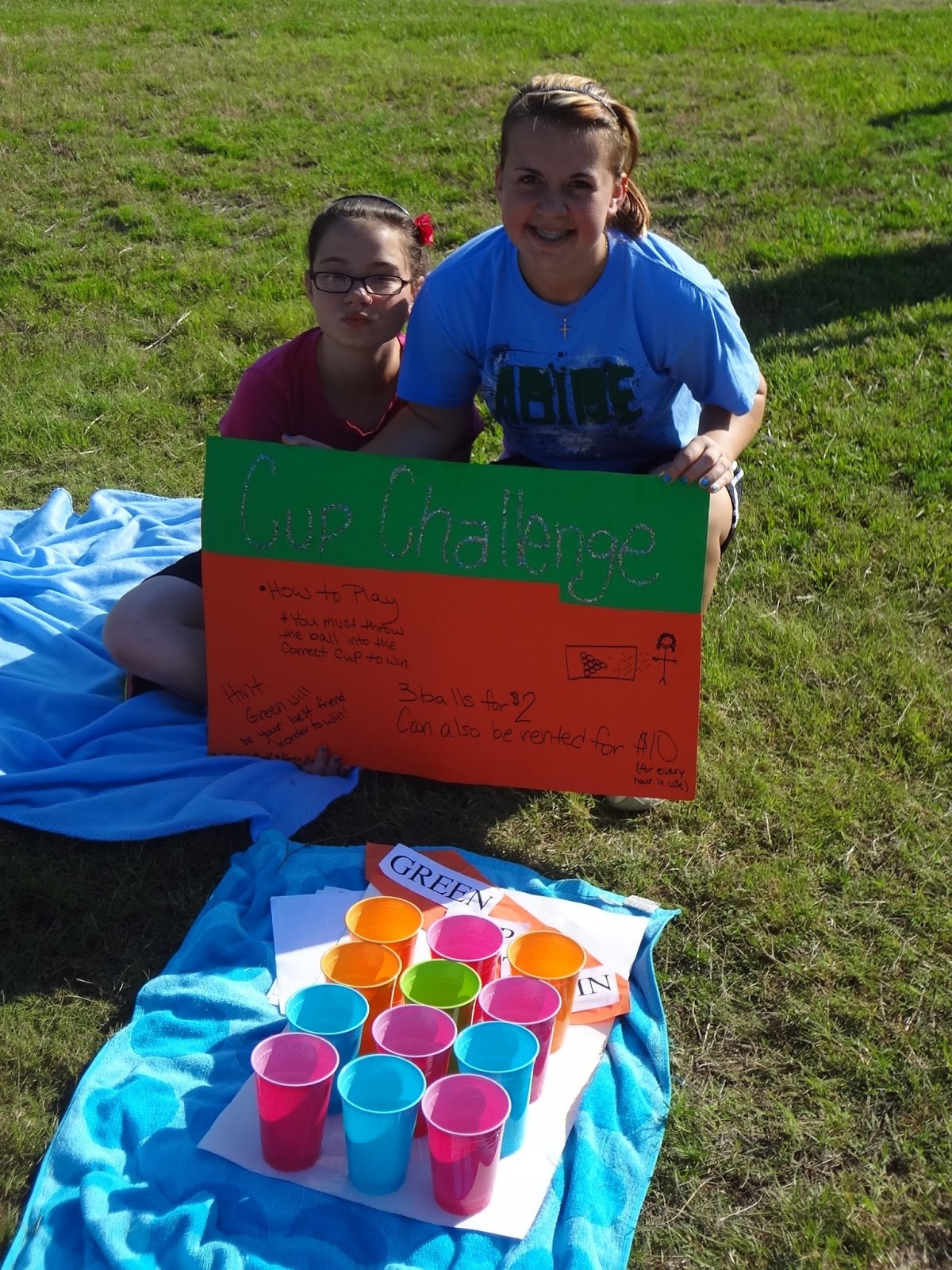
Some games are very simple.  Knock the Cups over - three plastic cups and a ping pong ball.  The goal is to knock the cups over with the ball.

Some games are more advanced.  Angry Beans - balloons and lima beans.  The goal is to pop the balloons by slinging a lima bean from a sling shot.

Some games are WAY more advanced.  Skeeball - a skeeball machine built by a student!!!  I was BLOWN away with this one.  WOW at the math that was used to build it!  He plans on donating it to his church for the annual fall fest.

When they come up with the income, they must decide how they would make money on this.  Some people say they will charge money for each play.  Others say they will rent the game out.
Example income equation:  i = 2t  ($2 per ticket) or i = 50h   ($50 per hour)

They must also decide what expenses are needed.  For example:  $.25 per cup, $.50 per ping pong ball
e = .25c + .50b

We talk about at what point they will finally start making money (break even).  The difference between profit and loss is discussed, so we talk about what could be done to make sure the game operates at a profit.
Example profit:  2t - (.25c + .50b)

The kids make a poster that shows the name and written instructions.  I do not make them include the income and expenses on the poster (since they won't really be making any money when we set the game up).

Usually, we set them up during class time, and we walk around and play all the games.  This year, we set them up at an Athletic fun day outside, so students from 6th and 7th were able to play.  All the kids really liked it.

Plinko

Cup stack

Bowling

SkeeBall

Ball toss

Guess the Song
I tell the kids that they can create a game with no cost to them or the parents.  The Guess the Song game featured included a boy humming a song, and the kids had to guess the name of the song.  I have had some create a tic tac toe board out of sticks and then use pine cones to try and make three in a row.  The grade is never based on how much money they spend to create it.

My kids have always loved this game, and it is a great end to the year.

You can go to my store for the complete instructions on the game.  Get the instructions here!

Happy Gaming!

Tuesday, April 30, 2013

The Amazing Math Race

I always have a six weeks project.  Four years ago, I was thinking of what project I could do for the fifth six weeks.  I had shown a few clips for CBS' Amazing Race during the year.  Of course these clips held mathematical content.  The class said it would be fun to do an Amazing Race, so the project was created.

The race has five questions with five events/obstacles.  It even has a detour and a roadblock.    The race features one question from the five categories:

Measurement
Probability/Statistics
Percent
Pythagorean Theorem
Proportions

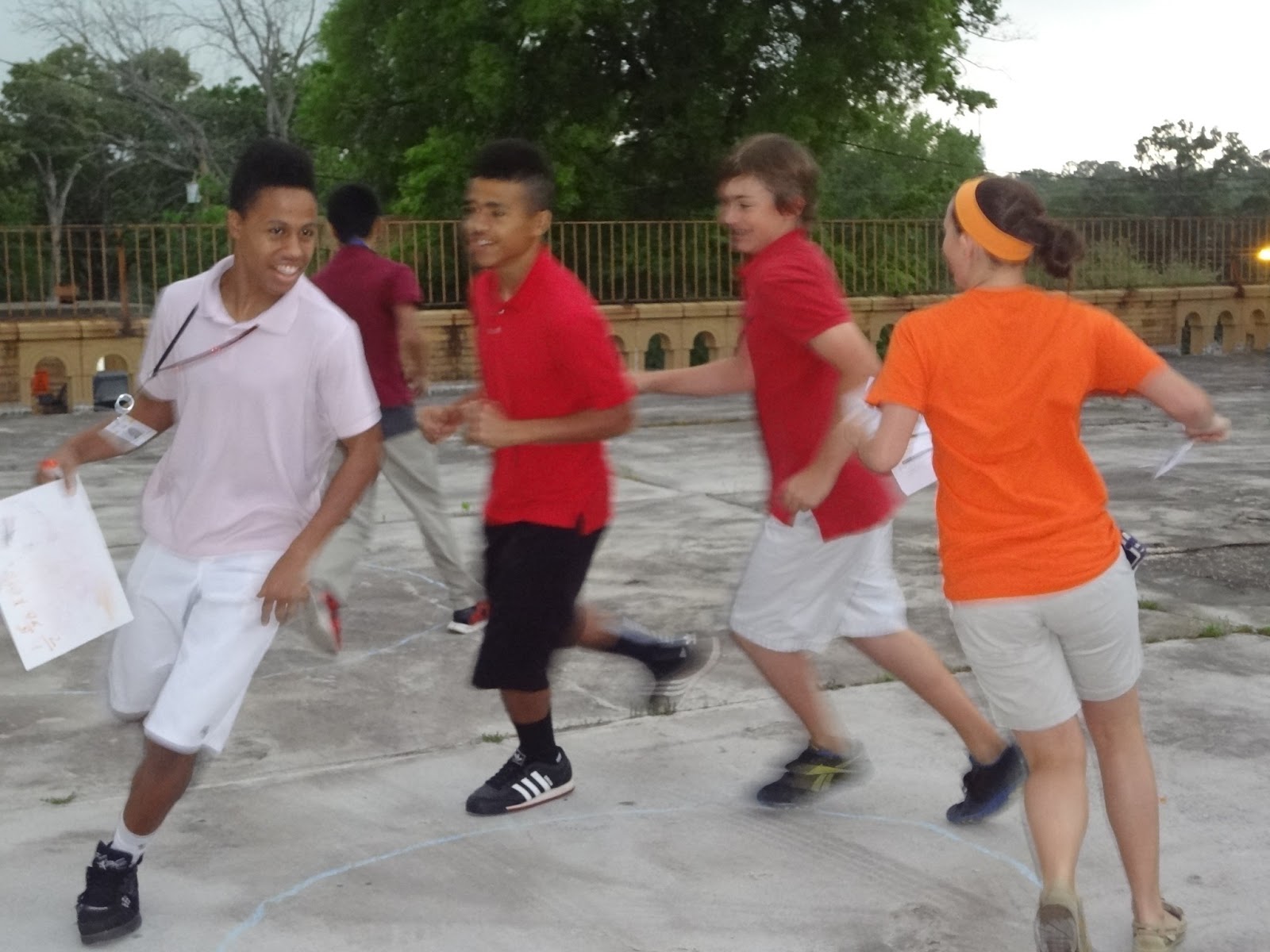
We go outside during the class and they perform my race (in groups of 3-4).  They have a blast!  They are answering math questions, being outside, and performing tasks.  They don't even look at is as being work.

Only one member can use his/her legs to go to the question.

Blowing bubbles

Measuring diameter

Pythagorean Theorem
I allow each group to have:
dry erase board with a marker
formula chart
calculator

Once they solve the question, they bring me the answer on the board.  I must be able to see the work, and the label (if any) must be correct.  I have flags set up for each question.  They must go to that flag to work or rework the problem.  Once they are correct, they get to complete the event.  It always goes very smoothly, and the competitive nature comes out.

I have each question printed on cardstock and laminated.  I have used the same questions since I started this four years ago!  I have enough questions for each group.  For my race, here are the items you will need in addition to the questions.
dowel rods, string and tape measure
hula hoops and measuring stick


Event flags (laminated and hot glued)

bubbles and bubble gum

After they complete my race, I give them the information sheet they need in order to create their own race.  They may work in groups of 3-4.  They must have five questions and five events.  It takes about two days to make it through all the groups. By the time we are done, the kids have answered 30-42 questions.  It is great, and we get to spend some time outside!

Here is the criteria:

The objectives of this project are to:
(1) help students better understand mathematical concepts and formulas by applying them in a fun and dramatic setting
(2) integrate math with competition and kinesthetics, providing students with the opportunity to utilize both their cognitive and creative abilities
(3) provide a motivational strategy that will encourage an appreciation for mathematics

The obstacle course must:

have 5 events and questions

feature the following mathematical concepts

  • Measurement
  • Probability/Statistics
  • Percent
  • Pythagorean Theorem
  • Proportions


feature the following obstacles

  • Road Block: A task in which only one team member can complete
  • Detour: A choice between two tasks, relating to the same concept
  • be contained to the “race area” and able to be performed


The questions must:

  • Be written one per page (enough pages for each group)
  • Have a solution provided to your teacher
  • Feature the mathematical concepts listed above


Here are some pictures from student created races.


If you would like the complete race, you can get it at my store.

The kids will enjoy it, and they are learning!

Happy racing!

Thursday, January 31, 2013

Math Sing-a-longs

For the last few years, I have done a sing-a-long project with my math class.

I give them the option of singing the song live in class, or pre-recording it and bringing in a video.  Most of the videos I receive are the kids standing and dancing to the song they made.  I love it when students go above and beyond the criteria.

This year, I had two really good videos.  They both had great original songs with a great video. The kids have voted in the classroom for the favorite video.  Since I created a class facebook this year, I have put the videos to a vote on there, as well.  I love seeing the parents promote and share the videos on their pages.  This has turned out to be a wholesome, family project with the voting.

Go to my facebook page and check them out:

Video 1:  Click here 
Video 2:  Click here 

Math in action

I am going to give both groups a prize, but the group with the most overall votes will get a special prize.  The next project is a commercial, and I have already heard different students say they were really going to work hard on it!  Cha-Ching!!!  Excited about math..... WooHoo!!!


The objectives of this project are:
(1) help students retain frequently used mathematical procedures by setting them to music/verse
(2) integrate math with music/verse/dance, providing students with the opportunity to utilize both their cognitive and creative abilities
(3) provide a motivational strategy that will encourage an appreciation for mathematics

Students will present an original song/rap and dance.
The song/rap must:
  •  have a catchy title
  • have a music accompaniment that will be played during the presentation 
    • music of any kind can be used (preexisting or your own creation)
    • preexisting songs can be used but the lyrics must be dubbed out
  •      be less than 2 minutes but more than one minute in duration
  •      consist of acceptable lyrics that cover any math topic (approved list)

Happy singing!

Monday, January 28, 2013

Nets of 3D figures

Nets are always a great way to help the students see what the 3D figure looks like.  The most difficult thing for them to grasp is that the base is not always what the figure is sittting on.  With this hands on activity, the kids are able to see the 2D form and then actually fold it into the 3D figure.

I gave the kids 5 nets:

  • rectangular prism
  • Triangular prism
  • Triangular Pyramid
  • Square Pyramid
  • Cylinder


I have copies from an old textbook, but I have found some on the internet that work, as well.
Here is one site:  http://www.senteacher.org/wk/3dshape.php

This year, I had the kids follow these steps:


  1. Sketch the net
  2. Identify the figure
  3. Identify the shape of the base
  4. Calculate the area of each base and face (use the actual net; NOT your sketch)
  5. Measure in cm
  6. Round to the nearest half cm
  7. You may use a calculator
  8. For the cylinder net, the rectangle part does not stay a rectangle; therefore, you cannot use lw for that part. It curves around, so for that part, you use: 2(pi)(r)(h)
  9. Calculate the height of the figure
We made 2d and 3d books, so they include the sketches and the information above in the back of that book.

After writing the above information, I also had the kids do the following to the actual net:
  • Color the base(s) of the figure
  • Cut the net out - Do NOT cut the tabs off
  • Fold the net and create the figure
  • Use GLUE
  • Create a mobile, by taping yarn to each figure

We hung the models from the ceiling.

As I was walking around the room, I would talk to them about what the base was.  Many of them still wanted to say the rectangle was the base of the triangular prism.  After I stood the prism up on the triangle, they were able to see that you could put it on any of the sides.  I hope it helped!

I had the kids in cooperative learning groups.  Phew!  I am worn out from all the same questions.  It is amazing since I:
  • Verbally gave instructions
  • Posted the instructions on the screen
  • Printed out instructions for each group

They don't take the time to READ.  Tomorrow, I have printed off a following directions test.  I cannot handle another day like Friday and today!  It is exhausting to say the same thing over and over.

I want to keep group work with the hands-on activities, so hopefully, the kids will learn better habits.

Here is a FREE copy of the posted and printed instructions I gave the kids.  

Happy net folding!


Thursday, January 24, 2013

2D and 3D Figures Book

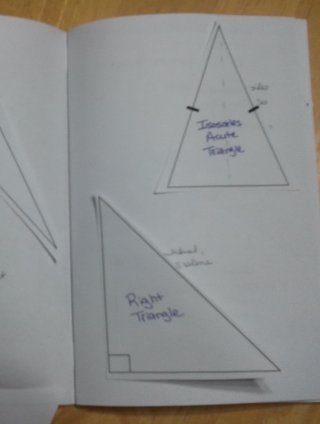
With 8th grade, Two-dimensional and Three-dimensional figures are review, so I spend two days going over both topics.  In the past, I have done the normal... take notes in a graphic organizer. This year, I decided to go with a hands on approach.  I created a book in which the kids will review all concepts about 2D and 3D figures.  We have worked on this the past two days, and it has been GREAT!

For this week, I have my desks set up in groups of 4 for cooperative learning.  I have 3 instruction sheets per group. They include:

  • Details of what should be on each page of the book
  • Details  for 2D figures
  • Details for 3D figures


I gave each student 5 pieces of paper that they used to create a booklet.  They also received a set of 2D figures, and on the second day, I gave them the 3D figures.

2D Figures Section:


  • Write the name on the figure
  • Under the figure write:
  • –Congruent sides
  • –Types of Angles
  • –Total # degrees d = 180(n-2) n is the # of sides
  • –Formula for Area
  • –Formula for Perimeter or Circumference


With this section, we spent about 10 minutes with a full class discussion over how to find the congruent sides, classify angles, and calculate the degrees.  We also discussed how to find perimeter when a formula is not given.  I gave everyone a formula chart, so they were able to refer to that for the area calculations.  We talked about how to find the area of pentagons, hexagons, etc.  With an illustration on the SMARTboard, the kids were able to see how to find these.  Complex figures can be tricky!!!

It nevers fails to amaze me that although these kids are in 8th grade, some of them have forgotten some if not all these facts.

3D Figures Section:


  • Cut the figure out and tape one side to the paper.
  • Write the name on the figure.
  • Under the figure, write:
  • •Name of base (all have a base except one)
  • •Number of edges (if any)
  • •Number of vertices (if any)
  • •Shape and number of


With this section we spent about 5 minutes with a full class discussion over the difference between prisms and pyramids.  We discussed that the base is not always what the figure is sitting on.

Throughout both days, I walked around the room talking with each group. I told them to raise their hand before they shaded in the bases to make sure they were correct.

Of course, since the first day of school, I have talked to them about how to ask a question.  NEVER just say, "how do I do this" or "I don't know".  Once they begin with what they do know and what they think they should do, I am there to ask them questions which helps them arrive at the answer.  When they find the answer, it always provides for better understanding.

Tomorrow, we are reviewing over nets, so they will be adding in measurements and characteristics on the last few pages of their book.

Over the next few weeks, we will go over Volume and Surface Area, so I have a 3d figures part 2.  In this section, we will go back and add the formulas for each figure.

I am very pleased with how this turned out!  I am glad that I turned this into a hands-on activity.

Go to my store to get the full activity complete with figures!

Happy Figure Reviewing!

Tuesday, January 22, 2013

All About Circles

I created this activity my first year teaching.  It has been one that I have shelved for the last few years, but I am dusting it off and bringing it back.  I even made a few changes.

In class this week, I am really hitting the cooperative learning aspect.  I have arranged my desks in groups of 4, so the entire class period will be spent with a group.  I hope they will be able to take away that group work is not about one person doing the work.  It is about being there to help someone else out.

With 8th grade, we do a quick review over 2d figures.  With this, I include a review over circles. With each group of desks, I have placed these items in a storage box:

  • scissors
  • bottle of glue
  • roll of tape
  • crayons or map colors
  • ruler


Each group will have an information sheet (one for the group), that details the parts of a circle.  They will each use a paper plate to create the same circle.  Each person will be responsible for his/her own circle.  Here are the materials:

  • paper plate
  • plastic straws
  • yarn 
  • glitter
I will manage these supplies and distribute as needed.  I don't like to waste, so these kids will learn how to recyle the left over glitter!

The students will follow these steps:

  • Outline the smaller circle within the plate
  • Use glitter to illustrate each radius (there are three)
  • Use a straw to illustrate the diameter
  • Use yarn to illustrate the chords
  • Shade each central angle one color
  • Shade the inscribed angle one color
  • Label the points


Of course, the diameter will have a straw, glitter and yarn.  In my example, I have them placed on top of each other to show each one.  On the back of the plate, they will create a key.  We will hang a few of them from the ceiling.  On Thursday, they will create a 3d mobile, as well, so my ceiling is about to leak geometry!

Go to my Store for the FREE downloadable activity.

I think the kids will enjoy the hands on activity, and I believe the parts of a circle will sink in a little more than if they just wrote it on paper.

They will also be modeling solids with blocks and beginning the 2d/3d book (I will post this tomorrow).  They are going to be busy little cubs tomorrow, but I find many of them work much better knowing they have a lot to do.

Happy circling!!

Monday, January 14, 2013

Cootie Catchers AKA fortune Tellers

How many of you remember making cootie catchers or fortune tellers as a kid?  I remember making a ton of them!  I decided to bring the concept into my classroom.

Identifying which equation could be used to solve a problem is a weak area.  In today's lesson, I had the kids answer 10 multiple choice problems out of Motivation Math.  All of the problems I selected asked them to find which equation could be used to solve the problem.  Here is what I had them do:

  • Read the problem
  • Analyze the problem (find the facts)
  • Solve the problem
  • Write the equation (the solution to the problem) 
  • If necessary, use a calculator and determine if the equation selected is reasonable.
  • Create another problem in which the same equations would need to be used.


The last part created a lot of discussion with many of the kids.  We went through this example as a class.
I can make $8 per hour babysitting.  If I work15 hours, which equation could be used to find t, the total amount of money earned?
a.  t = 15/8
b.  t = 8(15)
c.  t = 8/15
d.  t = 8+15
We agreed that equation b is what we would need.  I told them that they needed to create a brand new problem in which the equation, t = 8(15) would be used.  We came up with this.
There are 8 students in the class.  Each student has 15 pencils.  How many pencils are there in all?  Once we did this, a lightbulb went off for many of them.

Okay, now here is where the cootie catchers come into play.  I gave all the kids a white piece of paper in which I trimmed off the excess to make it a square (a big paper cutter is a time saver for this).
Here are the steps to make it:

  • Fold the paper and create a diagonal.
  • Unfold
  • Fold the paper again and create the other diagonal.
  • Unfold
  • Take each corner and fold it where the end meets the center of the paper.  Do this for all four corners.
  • Turn the paper over.
  • Take each corner and fold it where the end meets the center of the paper.  Do this for all four corners.
  • On the side with the squares, we put colors.  Some of the kids got creative and used highlighters, etc.
  • On each of the 8 triangles, we wrote the page number and problem to one of the problems I had assigned.  I assigned 10, so they chose 8.
  • Under the problem number flap, the kids wrote the equation they believe can be used to solve the problem.

We will finish this assignment up tomorrow.  I will have the kids go around the room with the cootie catcher they created, and they will play the game.  They will get to see if the equation they selected is the same as the other person.  If it is not, they will have a discussion as to why they selected the equation.
Outside part of the cootie catcher
Page number and problems listed on each triangle


Equation that can be used to solve the problem

The kids were really excited about making these.  Many of them had made them before and could not believe we were doing this in the math class.  They are anxious to go around the room tomorrow and actually play.

I am in the process of making some that can be used for measurement, formulas, etc.  That will be another post!

Happy Cootie Catching!

Thursday, January 10, 2013

FACEing Math

At a math conference two years ago, I came upon the booth FACEing Math.  The concept is to use problems and create a particular face.  Problems are designed for various topics and grade levels.  You give the students a paper with the intial outline of the head and a sheet with the problems.  If the answer is a, then they draw this.  If the answer is b, then they draw that.  There is even a book without problems, so you could design your own.

The kids really enjoy doing these.  I use these in math stations, and I also leave them when a substitute will be there.  A picture of what the finished product should look like, is also included in the book.  The kids are able to look at the correct picture and see where the mistakes (if any) were made.  Although, all of the faces should somewhat resemble the same thing, they are all still different.

We lost our art class this year, so I have tried to incorporate as much drawing, coloring, etc as I can.  Even though I teach 8th grade, the majority of them love to color!  It is fun to watch them try and sketch out some of the aspects.  I show them what my sketches look like, so they don't feel so bad!  An artist I am NOT!!!

Here is an example of what the sheet with the problems looks like.
This student highlighted the choice of the answer she selected.

When I left this for the sub, I only printed the first page.  There should have been two.  I am not really sure what happened there.  If I had printed the other page, all the colors would have been the same.  Since, I left it off, the kids chose what color they wanted to use.

Here are a few of the ones that are hanging up in the hall.
As you can tell, this one was an Egyptian face.

You can find more information about using FACEing math at her website:  http://www.faceingmath.com/facingmath/Main.html

I hope you are able to incorporate this into your classroom.  The kids really do enjoy it!

Happy FACEing!

Tuesday, January 8, 2013

Reindeer Activity

Wow!  The school year is flying by.  Do you dislike early release days?  Those are the most difficult days in which to keep the kids busy and in line!

A few years ago, I came up with this math reindeer activity.  I do this on the early release before Christmas break.  Of course, this project can be used at any time.  This project incorporates a hands-on activity with Pythagorean Theorem, sequences, expressions, and measurement (diameter and length).  I have questions for the kids to answer, but I am really just happy to make it through the day.  I take up the work, but it is one of those things that if they don't finish or if someone is absent, oh well.  


Items Needed:
            2 Popsicle sticks                                        Glue
            2 Pipe cleaners                                          Scissors
            1 sheet black construction paper                Ruler
            1 sheet red construction paper
            1 sheet white paper

Teacher’s Note: 
The jumbo Popsicle sticks allow for a wider faced reindeer, but regular Popsicle sticks work just fine. 
To glue the Popsicle sticks together, hot glue is the fastest way.  Hot glue is also useful when gluing the pipe cleaners to the sticks.  For safety, it is best for the teacher to operate the glue gun.  Remind the students that the reason it is called hot glue is because the glue is hot.  A helpful tool is the eraser on the pencil to push the items down once the hot glue is in place.
A time saver is to have stacks of white, red and black construction paper already cut.  Since the students will only need a small amount of paper, a regular piece of paper can get 8-10 square pieces of paper.
If perfect circles are desired (and time allows), a compass will be needed.  If a compass is not used, approximation is needed; therefore, all circles will be slightly unique.
The back of the information sheet is a great place to answer the questions.
For step 12, the glue, scissors and ruler may or may not be included in the # of items needed.  This may be specified or left to the student’s discretion.
Play some Christmas music to set the tone, and the students are able to leave the room with a great present for a loved one!

Reindeer created by a student

You can go to my tpt store for a student information sheet that is ready to be passed out.  

I know Christmas has already come and gone, but you can make a reindeer any time of the year!!

Happy Reindeer making!

Wednesday, November 28, 2012

Let the Voting Begin

The student created songs have been posted to our class facebook page.
Mrs-Cooks-8th-Grade-Math-Class-Going-Beyond-the-School

Here is the song that is currently in the lead!


Go to our facebook page and cast your vote!

I recorded the voices of the kids singing the songs.  The song with the most likes will win!  The kids are excited that other people can vote on their work!  It is also a great way to get the parents involved.

Our big project this six weeks is for the kids to work with a partner to create a song that teaches a concept. I have done this every year, and I usually get some really good ones.  They can pre-record it or present it live.  With the addition of the facebook page, I am planning on posting the best videos there.  We will have another voting session.  Of course, I will make sure the kids are able to have their picture or video posted.

I really think projects like this help with public speaking.  The kids have already had to present many times as a small group.  Now, we will see how they do with a partner.  They should take away some great skills to be used now and in the future!

Don't forget to go our facebook and like your favorite song!

Happy voting!


Thursday, November 15, 2012

Student Created Songs

Since the beginning of school, I have been writing songs to teach different concepts.  I have created songs for:
Dilations
Scale Factor
Tax, Discount and other Percent Apps
Fraction, Decimal and Percent equivalencies
Translations

Last week, I told my classes that they were now responsible for creating an original song that teaches Scientific Notation.  Since I have my classes in houses, each house had to create a song.

The songs were due today, and I was pretty impressed!  I always have my kids do a sing a long with a partner, but this is the first year I have given them songs I have created!  I think by allowing them to see how my songs teach a concept, they were able to create a pretty good song.  I wish I could say that all of them were great, but some were not!  I hope they use this as a learning tool and are able to create better songs as the year progresses.  I really believe that the sing along projects with a partner will be MUCH better this year!

One girl told me that she is not as nervous any more when she gets up in front the class.  I really think this is helping develop good public speaking skills, as well.  The first step in public speaking is to not be nervous in front of a group.

I told the kids that I would select the best song to add to our song portfolio.  I have two songs from my first class, one from my second and one from my last class that are in the running.  I think I am going to record them singing the songs.  I only want their voices (for now).  The performance factor will come in later!  I am thinking about posting them on my class facebook page for people to vote on the best song.  I only use the facebook page to post questions that the kids have created.  I believe this would be a good thing to add, as well.  I can see them working hard to get their song chosen.

It has been a busy year, so far!  I am really ready for Thanksgiving break!

Happy Singing!

Tuesday, October 9, 2012

Black Light Lesson

Two weeks ago, I completed my first black light lesson!  I went up to the school on a Sunday afternoon to black out my room.  I had some black sheets to cover my windows, and that worked great.  I didn't have enough, so I had to use paper.  That did not work as well.  I will definitely be getting more sheets to do this activity again.

I put up black butcher paper on an old chalkboard in my room.  I sprayed it with 3M adhesive spray (make sure you don't get the permanent kind).  It was about $18 at Office Depot, but you only need a little bit, so this can should last me a while.  I lined the trays with 4 black lights.  I have two black light bulbs that I put in flood light holders.  I hung these at the top.  I use all the these black lights at the dances, so I already had them.  I created different shapes, and I printed them out on neon cardstock paper from Hobby Lobby.  You can catch this when scrapbook materials go on sale for 50% off!  It goes through the printer beautifully!
This is what the board looked like as a whole.
I started my class like normal.  We created a quick foldable over the lesson.  The lesson was on Transformations:  Dilations, reflections, rotations, and translations.   When it came time for the lesson, I had the kids sitting with their backs to the wall move to the floor.  I pushed the desks over.  I turned the black lights on and the the main lights off.  The kids were mesmerized!  The foldable was made with neon paper, so it glowed too!
The O is for Original and the N is for New.
We went through different examples over the different transformations.  I also used a tri-fold board and created a coordinate plane with neon crayons. I used sticky tak to hold the shapes on the board.  I used neon color pom-pom balls.

Great representations of enlargements and reductions.


 The students really liked this.  I will definitely be using this in the future for another activity.  Overall, the students acted great.  I only had issue with one kid, and the other kids told him how he needed to act before I could.  They didn't want to lose the lesson!

Sunday, September 23, 2012

School is Rockin

Phew!  I am exhausted!  School is Rockin right along.

 This year, I am using the house system (Thank you Ron Clark....End of Molasses Classes).  Each class is divided into 1 of 6 houses.  They are able to earn points for different things.  At the end of a specified time, the house with the most points will earn a prize of some sort.

Last week, I handed all my students the lyrics to a dilation song.  I used the Firework song by Katy Perry and I created new lyrics based on dilations.  On the first day, we sang it as a class.  It was funny to listen to the kids.  Many of them cannot sing....just like me!  I told them that on Friday, each house had to perform the song.  Friday came and the performances began.....well I cannot call anything I witnessed a performance.  I had one group all day that actually had a performance....of some sort.  It was really only one student who blew me away.  I know that once I get them out of their comfort zones, the performance factor will happen....for some.

This week, I will present them with two more songs.  One about scale factor to Moves Like Jagger, and one about translations to Tonight Tonight.  I am thinking a math musical might be in store for my classes at some point.  They will be required to write songs as a house, so I will be interested to see how this goes.

Tomorrow, I am doing a lesson I have never done....Black Light Transformations.  I went up to the school today....on a Sunday!  I had to black out my room.  I put up my black lights.  I cannot wait to see how this goes.  I will post some pics tomorrow.

It has been super busy, but I know we are working hard and having fun.  I am almost convinced that my kids will be okay in the event that I have a sub.  We still have some more practicing to do.

Happy Rockin!

Friday, July 20, 2012

Math Creations with Chick Peas

Here is a fun activity I do with my kids when we review over 3d figures.  I like to do this before we get into surface area and volume.  Let's face it!  If they don't know which figure they are dealing with then the surface area and volume will more than likely be wrong!

Chick Pea Activity

Materials Needed:  Chick Peas, toothpicks, baggies or cups

Preparation:  You can purchase the peas in a can or dry in a bag like black eye peas.
The ones in the bag are much easier!  Just let them soak in water overnight.  The ones in a can stink!  Drain the water out, and they are ready to use.  Before each class, put about 1/3 cup of peas in a cup or baggie with some toothpicks.  Keep extras at the front for the kids to come up and replenish if necessary.


Objective:  Create 3d figures using chick peas and toothpicks.  The peas are used for the vertices of the figure, and the toothpicks are connected through the pea.  The students are able to create the figure, using a hands-on activity.  They are also able to make connections between the prism and pyramid. 


Create: 
Square Pyramid
Rectangular prism (remember a cube is still a prism)
Triangular Pyramid
Triangular Prism


After creating the four figures, have the students:
List the similarities and differences (at least two) between:


Triangular Pyramid and Square Pyramid
            Triangular Pyramid and Triangular Prism
Triangular Prism and Square Pyramid
Triangular Prism and \Rectangular Prism
Rectangular Prism and Square Pyramid
Rectangular Prism and Triangular Pyramid
Identify the shapes of the faces for each
Identify the shapes of the base(s) for each
Calculate the number of edges for each
Calculate the number of vertices for each

Extension:  If time allows, have the students create a different pyramid and prism.  Tell them they must be able to correctly name the figure.

Conclusion:  Discuss some of the similarities and differences as a class.  Make sure you go over the shapes of the faces for the pyramids and prisms.  Remind them how each figure is named for the shape of the base.  Also, the base is not necessarily what the figure is sitting on. 

Clean up:  For less mess, have the students dismantle the figures.  Place the toothpicks and unused peas back in the cup, and the used chick peas can be thrown away.  Keep a couple to use for examples.  Some kids will want to take at least one of the creations with them!


Thursday, July 19, 2012

Arrays can do so much

Do you use Arrays in the math class?  We do!  With arrays, you are able to accomplish so much:
  • Identify dimensions
  • label fractional parts
  • Calculate Perimeter
  • Calculate Area
  • Create Equivalent fractions with scale factor
  • Model the fractional parts
  • Compute the four basic operations


By the time I get the kids in 8th grade, we review over the arrays, but they are already familiar with them. I do not make the kids model every time they do a fraction computation, but it is a tool in their toolbelt.  Some of the kids do model each time because they see it that way.  Fractions are tough!  Modeling with arrays offer so much.

You can model with arrays with graph paper or you could use the color tiles.  In 8th grade, I focus on graph paper. 

The most difficult fraction computation is division!  We do not teach the short cut of "keep it, change it, flip it!"  We teach them how to divide the fractions.  The arrays do allow for a model to be created in which the kids get a better understanding as to what division of fractions means.  When you teach the shortcut, the understanding is lost!

Arrays are a great tool to arm the kids with. 

Happy Modeling!