Monday, February 25, 2013

Incentives! Incentives!

This year the change I made was to reward my kids more!  I have always given incentives to the whole class, but I really wanted to make more individual or small group rewards.

As mentioned in an earlier blog, I divided my classes into six houses.  For the first semester, the reward was a trip to a Dallas Mavericks game!  The kids were so excited.  We had a great time at the game, and it was wonderful to see the kids have a good time outside of school.  Some of them never get a chance to do anything like this.

For the second semester, I am rewarding a small prize at the end of each six weeks, and a bigger prize at the end of the second semester.  Of course, we will cut the second semester time frame a little short, so they can get the reward in.

The winners of the 4th six weeks will be announced tomorrow.  So many of them are so anxious and cannot wait to find out.  Now, I just need a good prize!  :)

I also rewarded a group who had an outstanding video for their sing a long project (also in a previous post).  Two groups went above and beyond the criteria, so we had a contest between the two videos.  The kids voted in class and we combined that with facebook votes.

I took the winning group to Air U in Longview Texas.  It is an indoor trampoline park. The boys had an absolute blast!  We have a contest going on right now with the commercial project, and I cannot wait to see what they do with it!


Regardless of what rewards you offer, your students will work hard to earn them!  We all win when they work hard!

Happy Rewarding!

Monday, February 4, 2013

Jib Jab part 2

I signed up for Jib Jab over the summer.  It is $12 for the whole year, and you can make countless cards and videos.

At the beginning of the year, I put a few of the kids faces in the jib jab video, and they really liked it. I have used it since for personal videos, but I had not used it in a while for school.

After our sing-a-long, we had a contest to see which video was the best.  I featured the stars of the winning video in a jib jab video and posted it on our class facebook page (permission has been given by the parents).


The kids enjoy seeing their faces dance around.  I recommend jib jab to any teacher. It is a great motivator.
Here is the jib jab video I created.  Sing-a-long Stars

Side note:
The students who created the winning video will have their name on a trophy that will stay in my classroom.  I am also treating them to an afternoon at AirU (an indoor trampoline park).


Happy Jib Jabbing!

Thursday, January 31, 2013

Math Sing-a-longs

For the last few years, I have done a sing-a-long project with my math class.

I give them the option of singing the song live in class, or pre-recording it and bringing in a video.  Most of the videos I receive are the kids standing and dancing to the song they made.  I love it when students go above and beyond the criteria.

This year, I had two really good videos.  They both had great original songs with a great video. The kids have voted in the classroom for the favorite video.  Since I created a class facebook this year, I have put the videos to a vote on there, as well.  I love seeing the parents promote and share the videos on their pages.  This has turned out to be a wholesome, family project with the voting.

Go to my facebook page and check them out:

Video 1:  Click here 
Video 2:  Click here 

Math in action

I am going to give both groups a prize, but the group with the most overall votes will get a special prize.  The next project is a commercial, and I have already heard different students say they were really going to work hard on it!  Cha-Ching!!!  Excited about math..... WooHoo!!!


The objectives of this project are:
(1) help students retain frequently used mathematical procedures by setting them to music/verse
(2) integrate math with music/verse/dance, providing students with the opportunity to utilize both their cognitive and creative abilities
(3) provide a motivational strategy that will encourage an appreciation for mathematics

Students will present an original song/rap and dance.
The song/rap must:
  •  have a catchy title
  • have a music accompaniment that will be played during the presentation 
    • music of any kind can be used (preexisting or your own creation)
    • preexisting songs can be used but the lyrics must be dubbed out
  •      be less than 2 minutes but more than one minute in duration
  •      consist of acceptable lyrics that cover any math topic (approved list)

Happy singing!

Monday, January 28, 2013

Nets of 3D figures

Nets are always a great way to help the students see what the 3D figure looks like.  The most difficult thing for them to grasp is that the base is not always what the figure is sittting on.  With this hands on activity, the kids are able to see the 2D form and then actually fold it into the 3D figure.

I gave the kids 5 nets:

  • rectangular prism
  • Triangular prism
  • Triangular Pyramid
  • Square Pyramid
  • Cylinder


I have copies from an old textbook, but I have found some on the internet that work, as well.
Here is one site:  http://www.senteacher.org/wk/3dshape.php

This year, I had the kids follow these steps:


  1. Sketch the net
  2. Identify the figure
  3. Identify the shape of the base
  4. Calculate the area of each base and face (use the actual net; NOT your sketch)
  5. Measure in cm
  6. Round to the nearest half cm
  7. You may use a calculator
  8. For the cylinder net, the rectangle part does not stay a rectangle; therefore, you cannot use lw for that part. It curves around, so for that part, you use: 2(pi)(r)(h)
  9. Calculate the height of the figure
We made 2d and 3d books, so they include the sketches and the information above in the back of that book.

After writing the above information, I also had the kids do the following to the actual net:
  • Color the base(s) of the figure
  • Cut the net out - Do NOT cut the tabs off
  • Fold the net and create the figure
  • Use GLUE
  • Create a mobile, by taping yarn to each figure

We hung the models from the ceiling.

As I was walking around the room, I would talk to them about what the base was.  Many of them still wanted to say the rectangle was the base of the triangular prism.  After I stood the prism up on the triangle, they were able to see that you could put it on any of the sides.  I hope it helped!

I had the kids in cooperative learning groups.  Phew!  I am worn out from all the same questions.  It is amazing since I:
  • Verbally gave instructions
  • Posted the instructions on the screen
  • Printed out instructions for each group

They don't take the time to READ.  Tomorrow, I have printed off a following directions test.  I cannot handle another day like Friday and today!  It is exhausting to say the same thing over and over.

I want to keep group work with the hands-on activities, so hopefully, the kids will learn better habits.

Here is a FREE copy of the posted and printed instructions I gave the kids.  

Happy net folding!


Saturday, January 26, 2013

Let's ALL raise our expectations!

I tried something different this past week at school.  Wednesday - Friday, I had my desks set up for cooperative learning.  We were working on review concepts: area, perimeter, 2d and 3d figures.  I know all of these concepts have been taught to them, but I am once again faced with the question as to HOW our students are taught.  

From the first day of school, I make it clear to my students that I am here to help them, but I will not hold their hands.  When they ask me a question, I expect it to take place AFTER they have pondered the question.  I NEVER accept "I don't know" or "I can't".  The biggest hurdle is teaching the students HOW to ask a question.  

When a student raises his/her hand, I go to them and ask them what they need.  In the beginning, many of them tell me they don't understand the question.  I then proceed with, "Okay. What is YOUR question."  The student will then proceed to read the question to me.  I then ask again, "What is YOUR question."  I tell them that I can read the problem written, but I need to know what they are confused about.  Once we get through that, I continue asking them various questions about the concept.  By the time, I am finished, the student has usually answered the question they had.  I see the lightbulb.  

Now, this concept is not well liked by many of my students. Most of my kids tell me that they have heard how hard I am.  I always take that as a compliment.  This past week, my kids conducted a survey in which they created a question and then had to do different things with the data.  One group asked who the favorite teacher was.  He thought it would hurt my feelings that I had only received a few votes.  I told him that I was not here to be the favorite teacher.  Most students do not like how hard I am and that I have high expectations.  I told him my feelings would be hurt if they said I was the easiest teacher.  I know that when students walk out of my classroom, I have done the best job I can to not only teach them math but provide them with tools they can use anywhere. 

We are NEVER finished in my class.  We have numerous projects going on in and out of the classroom.  The kids are given many opportunities to express and use math in many different ways.  I always see such a difference by the end of the year.  My kids learn many skills, and that is what they should learn in all classes.

As they were working in groups this week, I was shocked as to how many of them had no concept as to what perimeter and area really meant.  Most could tell me what the formula meant, but they had no idea what the concept meant. It just made me realize that not all teachers push the students like they could be pushed.  Self-discovery is a wonderful teaching tool.  I am always there to let the student know if what they discovered is correct, but they figured it out on their own.  That is powerful.  As teachers, we must realize that we need to let the students take control of their learning.  Let them find out the answers on their own, and we are there to offer support and help keep them on the path to learning.  Through life, we will make mistakes, and there are many times in which students arrive at a thought that is not correct.  Through effective questioning, we can easily get them back on the right track.   

Although it has been disheartening to see how unprepared some of these students are in the self-discovery path, it has also been wonderful to see what happens when they finally get it!  I am not saying that every student did not understand these concepts, but many of the students did not. I teach my students as if they were my own child.  I can only hope that my son's teachers push him to his highest potential.  

Imagine how wonderful our schools would be if we all set and kept our high expectations!  It is easy to just go over and tell a student how to find something out, but tomorrow that same student will have the same question.  Many students won't be happy about it at the time, but in a few years, the students will look back and appreciate what was done for them.  Let's give them the best we have, so they can be the best they can be!

Happy High Expectation Setting! 

Thursday, January 24, 2013

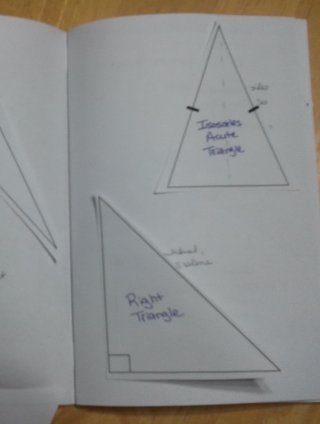
2D and 3D Figures Book

With 8th grade, Two-dimensional and Three-dimensional figures are review, so I spend two days going over both topics.  In the past, I have done the normal... take notes in a graphic organizer. This year, I decided to go with a hands on approach.  I created a book in which the kids will review all concepts about 2D and 3D figures.  We have worked on this the past two days, and it has been GREAT!

For this week, I have my desks set up in groups of 4 for cooperative learning.  I have 3 instruction sheets per group. They include:

  • Details of what should be on each page of the book
  • Details  for 2D figures
  • Details for 3D figures


I gave each student 5 pieces of paper that they used to create a booklet.  They also received a set of 2D figures, and on the second day, I gave them the 3D figures.

2D Figures Section:


  • Write the name on the figure
  • Under the figure write:
  • –Congruent sides
  • –Types of Angles
  • –Total # degrees d = 180(n-2) n is the # of sides
  • –Formula for Area
  • –Formula for Perimeter or Circumference


With this section, we spent about 10 minutes with a full class discussion over how to find the congruent sides, classify angles, and calculate the degrees.  We also discussed how to find perimeter when a formula is not given.  I gave everyone a formula chart, so they were able to refer to that for the area calculations.  We talked about how to find the area of pentagons, hexagons, etc.  With an illustration on the SMARTboard, the kids were able to see how to find these.  Complex figures can be tricky!!!

It nevers fails to amaze me that although these kids are in 8th grade, some of them have forgotten some if not all these facts.

3D Figures Section:


  • Cut the figure out and tape one side to the paper.
  • Write the name on the figure.
  • Under the figure, write:
  • •Name of base (all have a base except one)
  • •Number of edges (if any)
  • •Number of vertices (if any)
  • •Shape and number of


With this section we spent about 5 minutes with a full class discussion over the difference between prisms and pyramids.  We discussed that the base is not always what the figure is sitting on.

Throughout both days, I walked around the room talking with each group. I told them to raise their hand before they shaded in the bases to make sure they were correct.

Of course, since the first day of school, I have talked to them about how to ask a question.  NEVER just say, "how do I do this" or "I don't know".  Once they begin with what they do know and what they think they should do, I am there to ask them questions which helps them arrive at the answer.  When they find the answer, it always provides for better understanding.

Tomorrow, we are reviewing over nets, so they will be adding in measurements and characteristics on the last few pages of their book.

Over the next few weeks, we will go over Volume and Surface Area, so I have a 3d figures part 2.  In this section, we will go back and add the formulas for each figure.

I am very pleased with how this turned out!  I am glad that I turned this into a hands-on activity.

Go to my store to get the full activity complete with figures!

Happy Figure Reviewing!

Tuesday, January 22, 2013

All About Circles

I created this activity my first year teaching.  It has been one that I have shelved for the last few years, but I am dusting it off and bringing it back.  I even made a few changes.

In class this week, I am really hitting the cooperative learning aspect.  I have arranged my desks in groups of 4, so the entire class period will be spent with a group.  I hope they will be able to take away that group work is not about one person doing the work.  It is about being there to help someone else out.

With 8th grade, we do a quick review over 2d figures.  With this, I include a review over circles. With each group of desks, I have placed these items in a storage box:

  • scissors
  • bottle of glue
  • roll of tape
  • crayons or map colors
  • ruler


Each group will have an information sheet (one for the group), that details the parts of a circle.  They will each use a paper plate to create the same circle.  Each person will be responsible for his/her own circle.  Here are the materials:

  • paper plate
  • plastic straws
  • yarn 
  • glitter
I will manage these supplies and distribute as needed.  I don't like to waste, so these kids will learn how to recyle the left over glitter!

The students will follow these steps:

  • Outline the smaller circle within the plate
  • Use glitter to illustrate each radius (there are three)
  • Use a straw to illustrate the diameter
  • Use yarn to illustrate the chords
  • Shade each central angle one color
  • Shade the inscribed angle one color
  • Label the points


Of course, the diameter will have a straw, glitter and yarn.  In my example, I have them placed on top of each other to show each one.  On the back of the plate, they will create a key.  We will hang a few of them from the ceiling.  On Thursday, they will create a 3d mobile, as well, so my ceiling is about to leak geometry!

Go to my Store for the FREE downloadable activity.

I think the kids will enjoy the hands on activity, and I believe the parts of a circle will sink in a little more than if they just wrote it on paper.

They will also be modeling solids with blocks and beginning the 2d/3d book (I will post this tomorrow).  They are going to be busy little cubs tomorrow, but I find many of them work much better knowing they have a lot to do.

Happy circling!!